 For everyone
Big conversations
Questions I wish I’d asked sooner: what men and women across the US told us
Published · 11 min read · By Julia, 4Keeps founder
Everyone has a list of conversations they wish they'd asked their partner before they were 3 years, one lease, and a golden retriever deep. So we asked around to both men and women, young and old, across the US: what is the question you wish you'd asked sooner in a relationship?
Below are the responses that stuck with us.
The pattern across almost every answer: nobody regretted asking too early. They regretted assuming.
Kids and family
“Do you want kids? Not ‘someday.’ How many, and by when?”
Rachel, 34 · Woman · Denver, CO
We dated for three years and every time it came up, he said “someday, definitely.” I heard yes. What he meant was “I don't want to have this conversation.” When I finally pinned him down at 33, someday turned out to mean probably never. I don't regret loving him. I regret that I didn't make him give me a real answer in month two, when walking away would have cost me a few weeks instead of three years.
“How involved will your parents be in our life, and is that something you decide or something you inherit?”
Priya, 31 · Woman · Edison, NJ
His mom came to dinner every Sunday, which I thought was sweet. What I didn't know was that in his family the expectation was that she'd move in with the oldest son once his dad passed. I found out when his dad got sick, and he talked about it like it was already settled. It wasn't a bad plan. It just wasn't a plan I was ever asked about. We're working through it, but it would have been a much easier conversation before the wedding than in a hospital waiting room.
“What faith, if any, would our kids be raised in?”
Matt, 39 · Man · Nashville, TN
We were both “not really religious” when we met, so it never came up. Then our daughter was born and suddenly her being baptized mattered enormously to my wife, and it mattered to me that she not be. Turns out “not really religious” meant two completely different things for us.
“How many pets is too many pets?”
Tom, 38 · Man · Kansas City, MO
Her answer, which I should have taken more seriously, was “there's no such number.” We now have four dogs, two cats, and a tortoise named Gerald who will outlive us both. Gerald is in the will.
Money
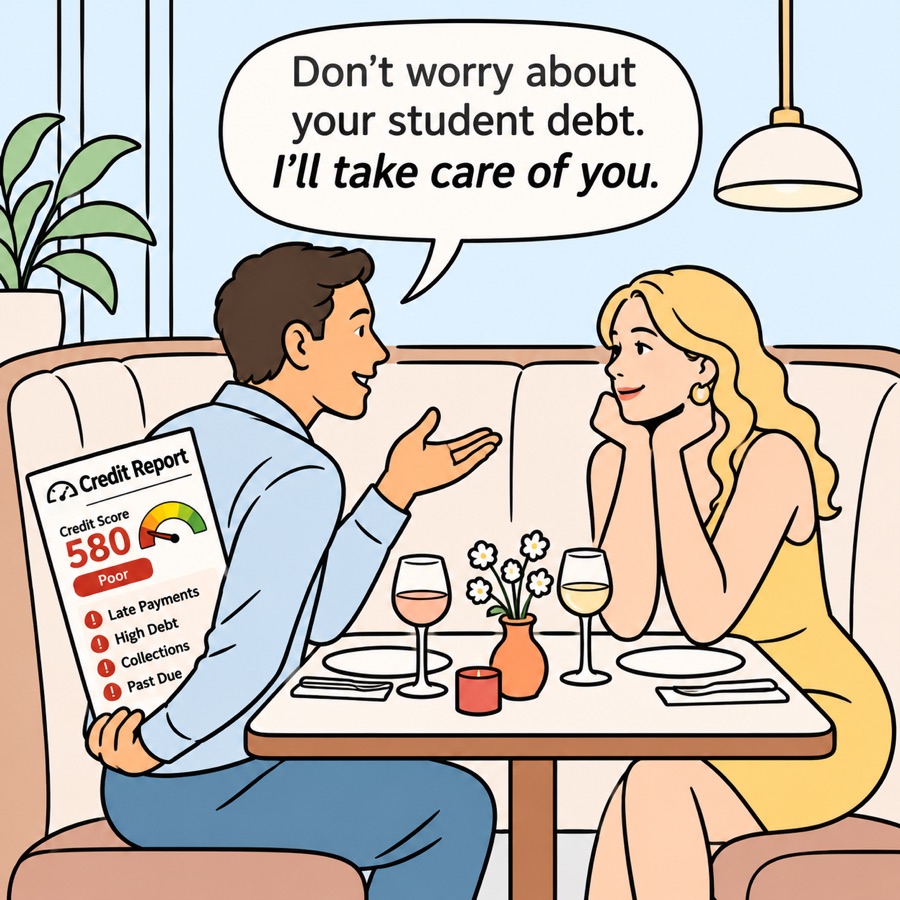
“What do you owe, to whom, and what's your credit score?”
Danielle, 38 · Woman · Phoenix, AZ
We got engaged, started house hunting, and the mortgage broker called me separately. My fiancé had about $86,000 in credit card debt and a tax lien I had never heard of. The debt honestly wasn't what hurt. What hurt was that we'd talked about money a dozen times and he'd let me believe he was fine. We postponed the wedding a year, did couples counseling, and got married anyway. But the trust took longer to rebuild than the credit score did.
“When we're married, is it our money, my money and your money, or some of each?”
Marcus, 41 · Man · Atlanta, GA
I grew up with parents who split everything down the middle. She grew up in a house with one checking account and no questions. Neither of us realized the other had a completely different picture until the first year of marriage, when I bought a $1,400 road bike with “my” money and she saw it on “our” statement. That bike started more fights than anything else in our first year. It wasn't about the bike. It was about whether we were a team or roommates.
“Do you have any money going out to an ex, like alimony or child support?”
Kim, 44 · Woman · Charlotte, NC
Not a problem in itself. A problem when you find out after you've signed a lease based on his income.
“When do you want to retire, and what do you actually picture doing?”
Frank, 63 · Man · Scottsdale, AZ
Thirty-one years of marriage, and we found out at 60 that I'd been saving for an RV and two years on the road, and she'd been saving to buy a house near our grandkids. Same pile of money, two completely different dreams. We're doing six months of each. Ask early, while you can still plan for both.
The past and the background
“Have you ever been arrested, charged with anything, or had a protective order filed against you?”
Tanya, 45 · Woman · Columbus, OH
Two years in, his new job ran a background check and he got nervous and told me before it came back: a domestic violence charge from his twenties, pled down to disorderly conduct. He said he'd changed, and maybe he had. But I'd moved my kids into his house by then, and I never got to make that decision with the full picture. Asking felt rude on date three. Not asking was much worse.
“Why did your last relationship end, in your ex's words, not yours?”
Daniel, 36 · Man · Seattle, WA
“Is there anything about your mental or physical health I should know about before we build a life together?”
Lauren, 47 · Woman · Raleigh, NC
My husband has bipolar disorder. I didn't learn that until a year into our marriage, when he went off his medication without telling anyone and we went through a very scary few months. I want to be clear: the diagnosis was never the problem. Lots of people manage it well, and he does now. The problem was that I had no idea what was happening, no idea what the warning signs were, and no plan. If I'd known, I could have been a partner instead of a bystander.
“How much do you drink in a normal week? Honestly.”
Eric, 35 · Man · San Diego, CA
Everyday life
“How do you fight, and how do you make up?”
Chris, 44 · Man · Chicago, IL
When she was upset she went quiet, sometimes for two or three days. When I'm upset I need to talk it out right now. So she'd retreat and I'd chase, and the chasing made her retreat further. We spent five years thinking we were incompatible. Turned out we just never talked about how each of us handles conflict until a counselor made us. Now she tells me “I need until tomorrow,” and I can live with that, because I know tomorrow is coming.
“What does cheating mean to you?”
Alicia, 27 · Woman · Los Angeles, CA
“Do you sleep with the TV on?”
Greg, 52 · Man · Tampa, FL
Nineteen years. The TV is still on.
“How often do you want to be intimate once life gets busy?”
Beth, 50 · Woman · Portland, OR
In the beginning, it was constant, so it never occurred to us to talk about it. Then came jobs, kids, and a mortgage, and it became clear that for him, twice a week was the bare minimum for feeling connected, and for me, twice a month felt like plenty. He felt rejected. I felt pressured. We didn't have the words for it for almost a decade.
“How do you act when you're sick?”
Jen, 29 · Woman · Austin, TX
He gets a cold the way Victorian poets got consumption. There is a bell now. I regret the bell.
“Who did the chores in the house you grew up in, and do you think that was fair?”
Jamal, 30 · Man · Philadelphia, PA
“What does a normal workweek look like for you, and do you want it to stay that way?”
Nicole, 42 · Woman · Dallas, TX
I married a man in the middle of building a company, and I assumed the 70-hour weeks were a phase. They weren't a phase. They were him. I wish I'd asked what he wanted his life to look like at 50, not what it looked like at 32.
“Is the thermostat a democracy or a dictatorship?”
Rob, 58 · Man · Minneapolis, MN
It's a dictatorship. I am not the dictator.
The future
“Where do you see yourself living in ten years?”
Sofia, 33 · Woman · Boston, MA
“Would you describe yourself as outdoorsy?”
Amanda, 32 · Woman · Salt Lake City, UT
He said yes. He meant he owns a Patagonia vest.
How to ask without it feeling like an interrogation
Reading this list all at once, you might worry that asking these questions will make you sound like you're conducting a deposition. You don't ask them all on date two. A rough order that works:
- First few dates: kids (yes, no, maybe), where they want to live, what they're looking for. These are screening questions, and it's kinder to both of you to ask them early. Our screening questions guide has phrasing that doesn't feel heavy.
- Getting exclusive: how they fight, why their last relationship ended, faith, drinking, what cheating means to them, family expectations.
- Talking about a future: debt and credit, obligations to an ex, health disclosures, criminal history, how you'll handle money together, retirement.
And go first. The fastest way to get an honest answer is to give one: “I'll be honest, I have about $30,000 in student loans left. What does your situation look like?” Disclosure invites disclosure.
The questions aren't the risky part. Building a life on answers you assumed is.