 For everyone
Honesty on apps
For everyone
Honesty on apps
Lying and withholding on your dating profile
Published · 9 min read · By Julia, 4Keeps
Almost everyone shades the truth a little on a dating profile, the flattering angle, the four-year-old photo, the job title rounded up. The temptation is obvious: apps are a brutal filter, and it feels like a small fib might get you past the gate. But the same fib you're tempted to tell is the one that infuriates you when someone else tells it to you. This is a two-sided look at lying and withholding on your profile, age, height, weight, photos, kids, divorce, income, so you can decide where your own line sits and read other people's honestly.
There's a real difference between withholding (keeping something private until it's relevant) and deception (creating a false impression). One is your right. The other has a due date.
The line that actually matters: privacy vs. deception
You do not owe a stranger your full biography before you've met. You are allowed to keep your last name, your employer, your address, your exact salary, and your custody schedule off a public profile. That's privacy, and it's smart. Deception is different: it's stating or strongly implying something untrue, or using material that no longer represents you, so the other person forms a false picture and invests based on it. A good test: would this person feel misled the moment we meet, or just newly informed? "Newly informed" is fine. "Misled" is the problem.
Side one: when you're the one tempted to fudge
Here's the uncomfortable math. A lie on a profile doesn't prevent the reveal, it just moves it to the worst possible moment: in person, after someone's excitement has already been built on the false version. You don't avoid the reaction; you guarantee a worse one, and you open the date with a broken trust you now have to overcome. Category by category:
- Age. Shaving off years virtually always surfaces, and the first thing your date learns about you is that you'll lie to get what you want. Far better: list your real age and let your energy, health, and photos do the arguing. If you're worried about search filters, that's a filter problem, not an honesty problem.
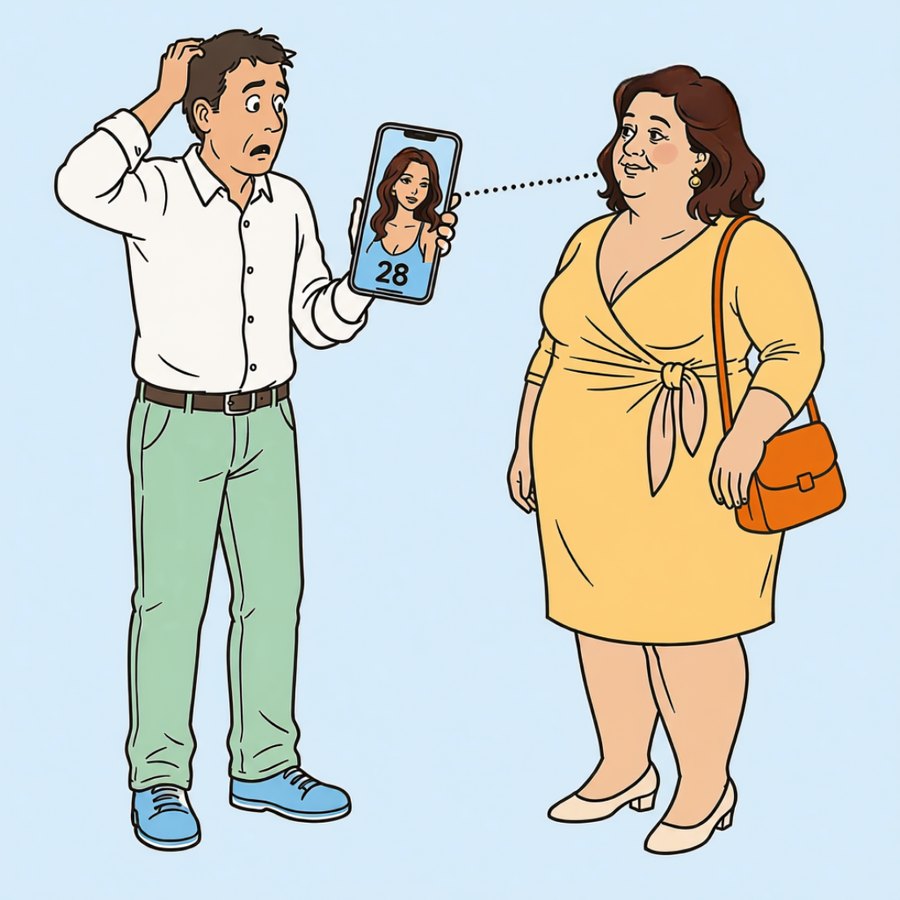
- Photos. The single most common and most resented fib. Old, heavily edited, or carefully angled photos set up the exact "you don't look like your pictures" moment that sinks a first date before hello. Use recent, real, well-lit photos, at least one clear full-length shot. Look your best, don't look like someone else.
- Height and weight. The classic two-inch upgrade gets clocked the instant you stand up. Be accurate. If a number scares off people who'd have rejected you in person anyway, it did you a favor and saved you an evening.
- Kids. This is not a fudge-able category. Whether you have children is core compatibility information, and hiding it reads as a serious deception because it changes the whole shape of a future. Say it plainly. You'll lose the people who were never options and keep the ones who matter.
- Divorce / marital status. "Divorced" is neutral to most adult daters, being secretive about it is not. You don't need the saga in your bio, but "divorced" (or "separated," accurately) belongs in the honest column. Framing beats hiding: see when to mention the sensitive stuff.
- Job and money. Inflating your title or lifestyle attracts people who want the inflated version, and now you have to keep performing it. Describe what you actually do with a little pride. Genuine ambition reads better than borrowed status.
The honest reframe: you're allowed to present your best true self. Your best photos, your most genuine strengths, the most appealing accurate version of your story. That's marketing. Faking a different self is fraud, and fraud always gets audited.
How to present favorably without lying
- Frame, don't fake. "5'8"" not "6 foot." "Recently divorced and in a great place about it" not silence. "I have two kids who are my world" not a blank.
- Lead with your real strengths. Put your genuinely best (and true) qualities front and center; you don't have to volunteer every vulnerability in the headline, only never to falsify.
- Control timing, not truth. Some things are fine to save for a conversation rather than the bio. Withholding the detail is your call; misstating it is not.
Already told a fib? Correct it early and plainly
If you fudged something and things are getting real, get ahead of it before they discover it. A light, non-dramatic correction, "small confession, I'm actually 46, not 43, I hate that I did that on the app", lands infinitely better coming from you than getting caught. The recovery is possible early. It's nearly impossible once they feel deceived.
Side two: when you're the one spotting it
Reading other people's profiles well means neither naive trust nor paranoid interrogation. Most fibs are vanity, not villainy, and a little grace is warranted, but patterns matter.
- Photos that dodge. Only group shots, only faraway or heavily filtered angles, no recent or full-length photo, these are the most reliable tells. It's reasonable to ask for a recent, casual photo before you meet.
- Vagueness where clarity is easy. Everyone can be private; watch for evasion on the basics (kids, marital status, whether they actually live where they say) when a straight answer would be simple.
- Story that keeps shifting. The age that changes, the job that upgrades between conversations, the "separated" that turns out to be "married," inconsistency over time is the real red flag, more than any single detail.
- How they handle being asked. A secure, honest person answers a direct question easily. Defensiveness, deflection, or turning it around on you for asking is information in itself.
Calibrate the response to the crime. A slightly old photo or a rounded-up height is a shrug. A hidden marriage, concealed kids, or a lie designed to extract money or time is a walk-away. For a fuller vetting toolkit, see screening questions that rule out red flags and how to run a background check.
When you do catch a small fib in person, name it lightly, don't ambush. "Your profile said 38, no big deal, but I'd rather we just be straight with each other" invites honesty instead of a defensive shutdown, and their reaction tells you plenty.
The bottom line
Every relationship built on a profile lie starts with a countdown to the moment it's found out. The whole point of dating is to be chosen for who you actually are, so the truth is the only version worth being liked for. Present your best real self, keep private things private until they're relevant, and extend, and expect, that same good faith. Honesty isn't just the ethical move here. On dating apps, it's the strategic one.