 Dating skills
Coffee dates: good or bad?
Published · 8 min read · By Julia, 4Keeps
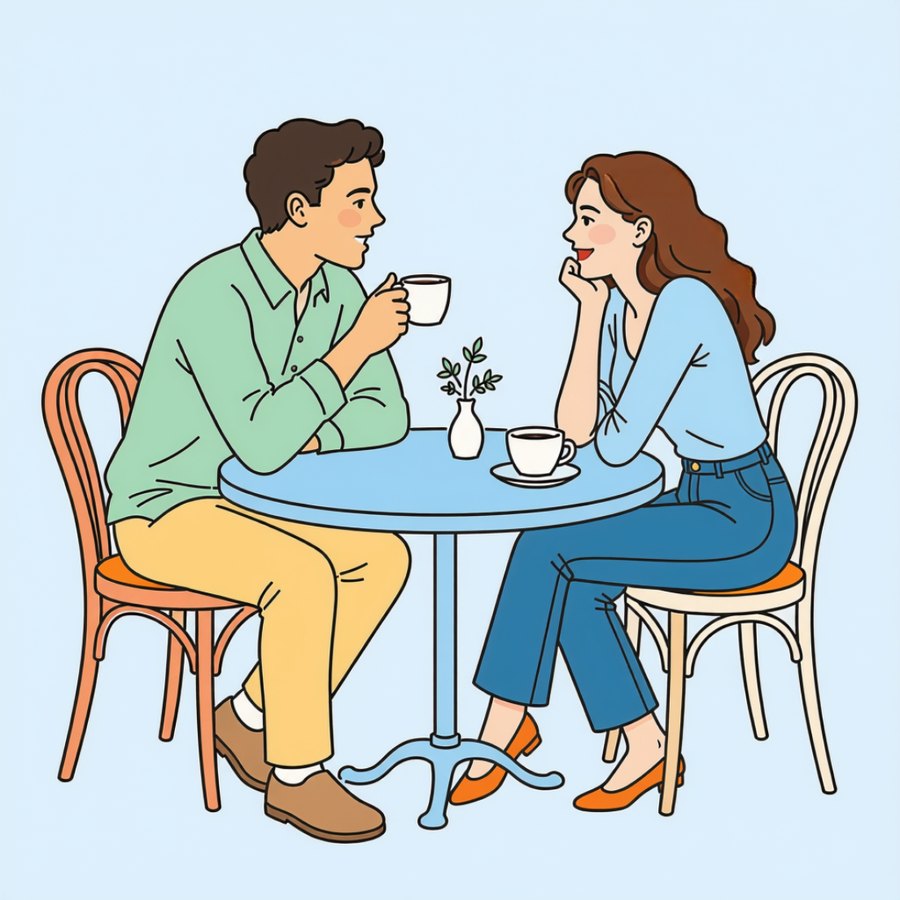
Coffee has a reputation problem. Say "let's just grab a coffee" and half the internet will tell you you've announced, in advance, that you aren't that interested. It's the date people apologise for suggesting. It's also, according to poll after poll, very close to the thing most single people actually want to be invited to.
Both of those things are true, and the contradiction is the whole article. A coffee date is an excellent way to meet someone. It is a mediocre way to date someone. Almost everything people argue about comes down to confusing those two jobs.
What the polls actually say
Start with the numbers, because the numbers are less dramatic than the discourse.
- Coffee is competitive, not dominant. When Censuswide asked 2,000 single people in April 2026 what they wanted from a first date, drinks came first at 31%, coffee second at 27%, and the traditional dinner third at 24%. Those three are close enough that any confident claim about what "everyone" wants is wrong.
- Americans split the same way, in the other order. A survey of 1,617 Americans put dinner at a restaurant on top with 30%, and a coffee shop right behind at 24%. Again: a six-point gap, not a verdict.
- Money is openly part of it now. In the same 2026 survey, 43% of singles said financial pressure was affecting how they date, and 59% said they were choosing cheaper options like coffee because of it. Coffee isn't only a preference, it's a budget.
- A flat first date is not a rejection. Match's 2026 Singles in America study of about 5,000 US singles found 41% would take a second date even when the first one wasn't exciting. That matters more for coffee than for anything else, and we'll come back to it.
Read the polls carefully and the real finding isn't "coffee wins." It's that the field is split roughly in thirds, which means guessing costs you, and asking costs you nothing.
The case for coffee
The arguments for it are better than its reputation suggests.
- It's short, and short is honest. Forty-five minutes is enough to learn whether you want more and not nearly enough to trap either of you. Dinner commits two strangers to roughly three hours before either has any evidence it's a good idea.
- It removes the safety negotiation. Meeting a stranger in a bright, busy, public place in daylight, with your own transport and no alcohol, is what a lot of people want from a first meeting and feel rude asking for. Coffee gives it to them without anyone having to raise it.
- It kills the bill problem. No one is performing generosity, no one is doing arithmetic, no one feels bought. You can be generous over six dollars without it meaning anything.
- It lets a good date grow. A coffee that's going well can turn into a walk, then a drink, then dinner, and the whole evening feels like something you discovered rather than something you booked. Dinner can't expand. It can only run long.
- It protects you from the sunk-cost trap. Nobody has ever sat through an hour of a bad coffee out of politeness about the reservation.
The case against coffee
And the arguments against it are better than its defenders admit.
- As your only offer, it reads as a hedge. This is the real objection, and it's fair. Coffee costs you almost nothing: no money, no evening, no planning. When it's the only thing you propose, some people correctly hear "I've kept my investment as low as possible until I've seen you in person."
- Cafes are often terrible rooms for it. Bright light, hard surfaces, a queue three feet away, someone grinding beans, a laptop worker glaring at you for talking. Very little about a busy coffee shop at 11am helps two nervous people relax.
- There's no structure to hide behind. Dinner has a shape: menus, ordering, courses, a natural rhythm with built-in pauses. Coffee is just two people and a conversation. If the conversation stalls at minute eight, there is nothing else happening in the room to carry you.
- The hard stop can cut off something good. Plenty of coffee dates are scheduled in a gap before work, which means the one date that was going somewhere gets guillotined at 9:45.
- It's the wrong gear for some people. Someone who has arranged childcare, driven an hour, or rearranged a shift did not do all of that for a flat white. Effort should roughly match what the other person is spending to be there.
So, good or bad?
Good when it's chosen. Bad when it's defaulted to.
That's the entire distinction, and it holds up against everything above. A coffee date that both people picked because they wanted something light and low-pressure is a genuinely excellent first meeting. A coffee date that happened because one person didn't want to commit to anything more, and never offered an alternative, is a signal, and the other person usually reads it correctly.
Which is why the strongest move isn't choosing between them. It's offering both and letting the other person decide, which we make the case for in detail in the first date, done right. Naming a real dinner plan shows you're willing to invest. Offering the lighter option in the same sentence means they never have to choose between seeming difficult and feeling cornered. You get credit for the effort either way, and you find out something about them from which one they pick.
How to run a coffee date so it doesn't feel like one
- Pick the place yourself, and pick a good one. Somewhere with proper seating, tolerable noise, and a corner you can talk in. "A coffee somewhere?" is not a plan. Naming a specific cafe at a specific time is most of the effort people say coffee dates lack.
- Go late afternoon rather than early morning. The room is calmer, neither of you is rushing to a desk, and it sits next to the evening, so it can extend if it's working.
- Leave the back end open. Don't book it against a hard stop. Have a second move in your pocket: a bookshop, a park, a bar around the corner. The date that turns into something else is the one people remember.
- Pay for the coffee. It's six dollars. Don't make it a moment, just handle it.
- End it on purpose. Leaving while it's still good is better than draining it. People remember an experience by its best moment and its ending, which is a well-replicated finding, not a dating-coach aphorism. A warm ending beats an extra half hour.
- Say something that day. Hinge's data is blunt here: 75% of daters expect to hear from you the same day or the next, and 49% have stopped themselves messaging after a date they enjoyed because they worried it was too eager. It wasn't too eager. Send it.
When coffee is the wrong call
A few situations where you should skip it and plan something real:
- They're travelling a long way to see you. Match the effort they're spending.
- They can only do evenings. Offering coffee to someone whose only free window is 8pm isn't low-pressure, it's inconvenient.
- It's the second date. Coffee's whole value is that it's a cheap first look. Repeating it after you already know you like them starts to read as indifference.
- You've been talking for weeks. If you've built real momentum over text, a forty-minute coffee can feel like a step backwards.
The part people get wrong afterwards
Because coffee dates are short and unglamorous, they get judged harshly. An hour in a bright room with a stranger, with no wine and no candlelight, is never going to feel like a scene from a film, and people take that flatness as proof there's nothing there.
It usually isn't. Remember the 41%: nearly half of singles would take a second date after a first one that wasn't exciting, because they understand that nerves, fluorescent lighting and a forty-minute window are not a fair test of anybody. The question a coffee date can answer is small and useful, do I want more time with this person. The question it cannot answer is whether you like them. That takes a second date, and the second date is where you finally book the dinner.
Sources
- Censuswide for Plenty of Fish, as reported by Yahoo Finance UK 2,000 UK singles who are dating, surveyed April 2026 — drinks 31%, coffee 27%, dinner 24%; 43% say financial pressure is shaping their dating habits and 59% are picking cheaper options such as coffee.
- Shane Co., “First Date Habits & Preferences of Americans” 1,617 Americans surveyed over a week in March 2022 — dinner at a restaurant 30%, coffee shop 24%; 86% spend longer than usual getting ready.
- Match / The Kinsey Institute, Singles in America (15th annual) ~5,000 US singles aged 18+, surveyed online March–April 2026 — 41% would consider a second date even if the first was not exciting.
- Hinge, “The Follow-Through Formula” 75% of daters expect a follow-up message the same day or the next; 49% have held back after a great first date for fear of coming on too strong; 47% want a match to express interest in meeting again without pinning down details.
- Pew Research Center, key findings about online dating in the US — context on how many people meet through apps and how first meetings get arranged.
- Kahneman, Fredrickson, Schreiber & Redelmeier (1993), “When more pain is preferred to less: adding a better end” Psychological Science, 4(6), 401–405 — the peak-end rule, and why how a date ends outweighs how long it ran.