 Dating skills
The first date, done right
Published · 7 min read · 4Keeps training library
A first date carries far more pressure than it deserves. It isn't an audition, an interview, or a referendum on your worth. It's a low-stakes way to answer one small question: do you want a second one? Treat it that way and almost everything gets easier. The people who date well aren't smoother or better looking, they've simply stopped treating each date as a verdict and started treating it as a conversation.
Plan it well
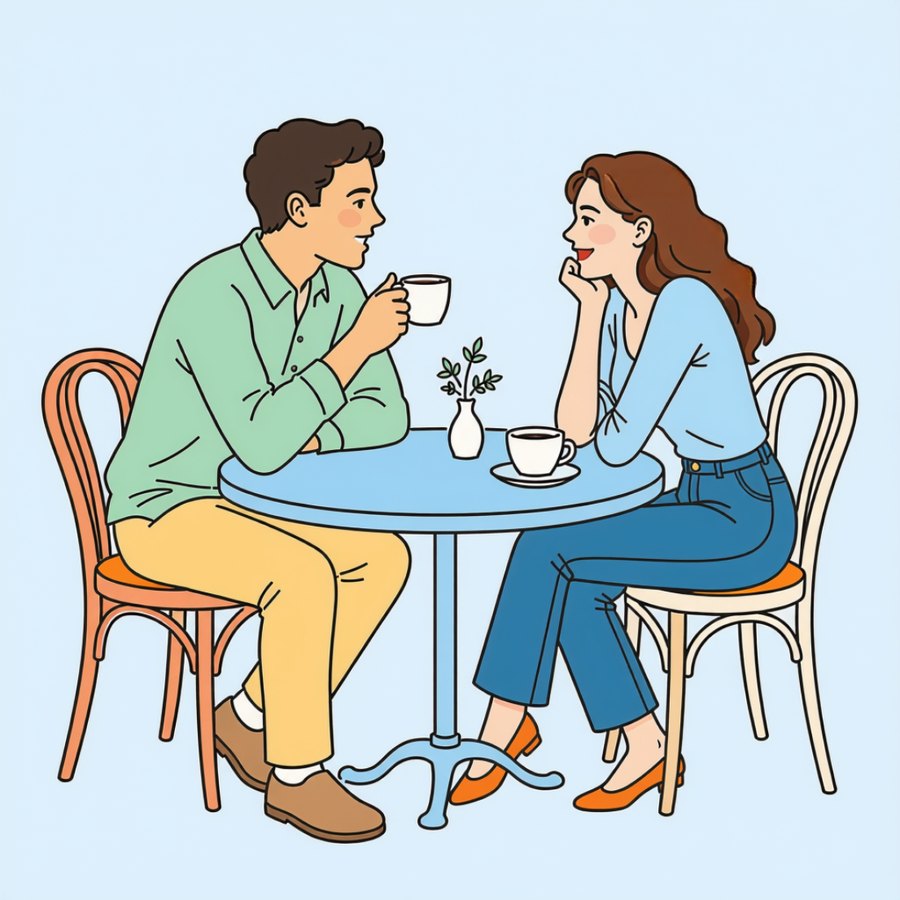
- Keep it short and side-by-side. A drink, a coffee, a walk. Something with a natural end so a great date can be extended and an awkward one can wrap up gracefully.
- Pick somewhere you can actually talk. Skip the loud bar and the movie where you can't say a word.
- Lower the stakes on purpose. The goal isn't to impress; it's to find out if there's something real to build on.
- Choose somewhere you feel at home. A place you know quietly steadies your nerves and lets more of the real you show up.
- Have a soft plan, not a script. Know where you're going and leave room for the night to surprise you.
Men: offer dinner or coffee and drinks, and let her pick
This is the single easiest thing a man can get right, and most get it wrong in one of two directions. Some default to a full dinner reservation, which quietly asks a stranger to commit two or three hours and sit through a plated meal with someone she may want to leave after twenty minutes. Others default to "let's just grab a coffee," which is easy and safe but can read as low effort if it's the only thing on the table. The optimal move isn't picking one. It's offering both and letting her choose:
"I'd love to take you to dinner at [place] Thursday, or if you'd rather keep it easy for a first meet, there's a great coffee spot / wine bar nearby. Whichever you prefer."
That one sentence does four things at once, and it's why it outperforms either option alone:
- It shows you're willing to invest without demanding she match it. Naming a real dinner plan signals effort and intent. Offering the lighter alternative in the same breath means she never has to weigh "is he serious?" against "is this too much, too soon?"
- It hands her control of the stakes, which is mostly a safety question. She's meeting a stranger. A short, public, daytime-or-early-evening meet is the option many women want on a first date and feel awkward asking for. Offering it first means she doesn't have to negotiate, and being the man who thought of it lands better than almost anything you could say over dinner.
- It respects the money question on both sides. Cost is openly shaping how people date right now, and a first date that quietly costs a hundred and fifty dollars adds pressure neither of you needs on night one. Save the real dinner for date two, when you both actually want the extra two hours.
- It tells you something before you've spent a cent. How someone answers a simple either/or is information. Enthusiasm for either option is a good sign. A vague non-answer is also a good sign, of something else.
The data backs the instinct. When 2,000 single people were asked what they actually want from a first date, drinks (31%) and coffee (27%) both beat a traditional dinner (24%), with 43% saying financial pressure is shaping those choices outright. A US survey found the same split, dinner at a restaurant 30% against a coffee shop 24%, close enough that guessing wrong is a real risk and asking costs you nothing. Offer both and you're right either way.
One caveat: offering the choice is not the same as having no plan. Name a specific place and a specific day for each option. "Dinner at Marlowe or coffee at Ritual, Thursday at 7?" is a plan with a choice in it. "Whatever you want to do sometime" is not an option, it's an assignment.
Steady your nerves before you arrive
Nerves aren't a sign something's wrong; they're a sign you care. The goal isn't to eliminate them, it's to keep them from running the show. A few things help: arrive a couple of minutes early so you're settled rather than scrambling, take a slow breath before you walk in, and reframe the whole evening from "I hope they like me" to "let's find out if I like them." That single shift moves you from performing to noticing, and noticing is where the real information is.
You're not there to be chosen. You're there to choose. Walk in as the person deciding, not the person auditioning.
While you're there
Be curious before you try to be interesting. Ask open questions and actually listen to the answers. Put your phone away, all the way away. Pay attention to how you feel in your body, relaxed and engaged, or guarded and performing. That feeling is data.
Notice how they treat the people around you, how they handle small hiccups, a wrong order, a long wait, and whether the conversation flows both ways. Warmth, presence, and genuine interest tell you more than a perfect résumé ever will.
Conversation that actually connects
Good first-date conversation isn't about clever lines; it's about depth over data. Anyone can trade job titles and hometowns. Connection comes from questions that invite a story:
- "What's something you're really into right now?"
- "What does a good weekend look like for you?"
- "What's something you changed your mind about recently?"
- "What made you want to meet up tonight?"
Then follow the thread. The magic is rarely in the first answer; it's in the follow-up question that shows you were actually listening. Share, too, don't interrogate. The best conversations volley: they open up a little, you match it, and the disclosure deepens naturally on both sides.
What to ignore
Don't over-read a lack of instant fireworks. Attraction often grows on the second or third meeting once nerves settle, and some of the strongest relationships started as a pleasant, unremarkable first date. You're not alone in thinking so: in Match's 2026 Singles in America study of roughly 5,000 US singles, 41% said they'd take a second date even when the first one wasn't exciting. Don't try to decide your whole future by the end of the night either, you're only deciding whether you're curious enough to keep going. And don't confuse a smooth performer with a good partner; charm is easy on a first date, character shows up over time.
Reading the signals for a second date
By the end of the night, you don't need certainty, just a lean. Good signs are simple: the conversation kept finding new places to go, you felt more relaxed at the end than the beginning, and you were a little disappointed it was ending. The clearest signal of all is the one people ignore: do you want to see them again? Not "should I," not "do they check the boxes," but do you actually want to. Trust that over the checklist.
Afterward
If you had a good time, say so clearly, and don't play games about timing. A simple "I really enjoyed tonight, I'd love to see you again" is more attractive than any calculated wait. Hinge's data puts numbers on it: 75% of daters expect to hear something the same day or the next, and 49% have talked themselves out of messaging after a date they genuinely enjoyed because they were afraid of coming on too strong. The waiting game has no winners in it. If you didn't feel it, a kind, honest message beats vanishing. Ghosting feels easier in the moment and worse for everyone, including you; how you end things is part of who you are, and word travels.
4Keeps clients get to skip the hardest part of all this: the guessing. We brief you before each introduction and debrief with you after, so every date teaches you something, whether or not it leads to a second.
Sources
- Match / The Kinsey Institute, Singles in America (15th annual) ~5,000 US singles surveyed March–April 2026 — 41% would consider a second date even if the first wasn't exciting.
- Censuswide for Plenty of Fish, as reported by Yahoo Finance UK 2,000 UK singles, April 2026 — drinks 31%, coffee 27%, dinner 24%; 43% say money shapes their dating choices.
- Shane Co., “First Date Habits & Preferences of Americans” 1,617 Americans, March 2022 — dinner at a restaurant 30%, coffee shop 24%.
- Hinge, “The Follow-Through Formula” 75% of daters expect a follow-up message the same or next day; 49% have held back after a great date for fear of seeming too keen.