 For everyone
Mate value
For everyone
Mate value
Are you the reacher or the settler?
Published · Updated · 7 min read · By Julia, 4Keeps
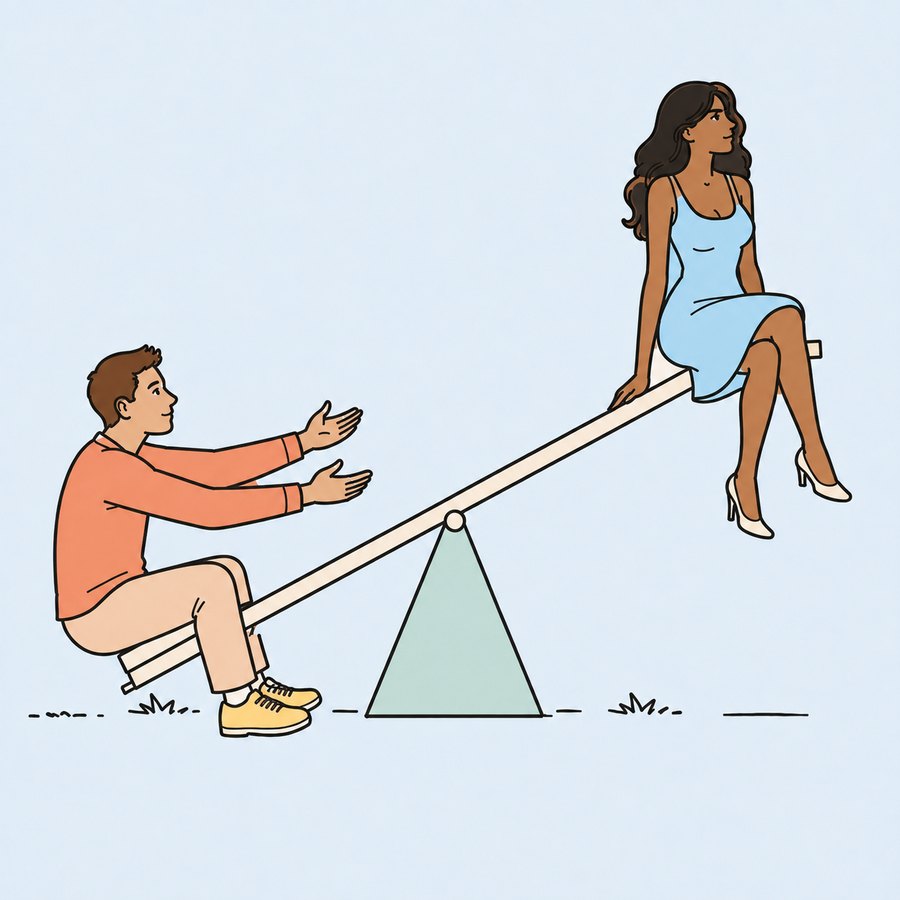
Researchers who study "mate value" have found something a little uncomfortable: in a lot of couples, the two partners aren't perfectly matched in how desirable they're seen to be. One person is the reacher, seen as having landed someone a notch above their own level. The other is the settler, seen as the bigger catch. It sounds harsh put that bluntly, but it isn't a verdict on anyone. It's a lens, and used honestly, it tells you a lot about the dynamics in your relationship.
So which one are you? Take the ten-question self-assessment below. Answer for your current relationship, or, if you're single, for your most recent one or the kind of person you usually end up with. Go with your gut, not the answer you wish were true.
Almost every couple has a reacher and a settler. The happiest ones just don't feel like it, because their strengths are different currencies that roughly balance.
What "mate value" actually is
Mate value isn't one number floating over your head. It's a messy bundle of things: looks, status, warmth, ambition, kindness, humor, stability, health, and a sense of fun. People weight those traits completely differently. One person is drawn to drive and success; another cares far more about gentleness and being easy to be around. So you can be a "reacher" in one person's eyes and clearly the catch in someone else's. There's no universal scoreboard, only overlapping, subjective ones. That's why the questions below ask how the relationship feels and how you behave in it, not how you'd rate each other on paper.
The self-assessment: reacher, settler, or peer?
Scoring it yourself: count your answers. Mostly first options means you lean reacher. Mostly last options means you lean settler. Mostly middle options, or a mix, means you're closer to peers.
If you're the reacher
You feel like you landed someone a little above your level. That isn't bad news. Reachers bring real strengths to a relationship, and a few real traps.
- Strength: gratitude. Reachers often feel genuinely lucky, which keeps them appreciative rather than entitled.
- Strength: effort. They tend to invest more and refuse to take the relationship for granted, which is exactly what long-term love needs.
- Trap: insecurity. That same awareness can curdle into anxiety, jealousy, or a nagging fear of being found out or left.
- Trap: over-functioning. Some reachers try so hard to "earn" their partner that they over-give and lose themselves.
- Trap: tolerating too little. Fear of loss can lead you to accept less respect or worse treatment than you ever should.
What to do: invest from abundance, not fear. The goal isn't to grip your partner tighter. It's to keep your own value high: your life full, your growth going, your standards intact, so staying is a choice you're both freely making rather than something you're clinging to. Confidence is far more attractive than scrambling to earn someone.
If you're the settler
You're seen, by yourself or others, as the bigger catch. Being the higher-value partner has its own upsides and its own quiet dangers.
- Strength: security. Settlers usually feel chosen and steady, which makes them more relaxed and less prone to anxious games.
- Strength: calm. That steadiness can be an anchor for the relationship when things get stressful.
- Trap: complacency. Feeling like the catch can quietly become an excuse to stop trying.
- Trap: taking them for granted. When you assume you could always do better, you start undervaluing the person right in front of you.
- Trap: the "what if" itch. A low hum of "could I have done better?" corrodes contentment from the inside if you let it run.
What to do: don't coast. The fastest way to turn a "settle" into a real regret is to stop trying and let your partner feel like a consolation prize. Choose them on purpose, every day, out loud. The security you feel is a foundation to build on, not a reason to check out. And if the "what if" is loud and constant rather than occasional, take that seriously: it's worth an honest conversation with yourself about whether you're staying for the right reasons.
If you're peers
This is the sweet spot. The durable pairings I see feel equal even when the specific currencies are different. He's better-looking; she's more accomplished. One brings stability and calm; the other brings adventure and spark. The totals land in roughly the same place, they're just built from different strengths. Trouble tends to show up only when one person deep-down believes they reached way too far, or settled way too low.
What to do: protect it. Keep investing in your own growth so the balance stays a balance, keep noticing and naming what your partner brings, and resist the urge to start tallying. Similar overall value, different shapes, is exactly what you want.
The trap of keeping score
Whatever your result, remember what this frame is for. Reacher-and-settler is a mirror, not a scoreboard. Couples who sit around tallying who out-punches whom, who "could do better," who got the better deal, breed resentment fast. The moment either person starts running the numbers, the relationship stops being a partnership and becomes a competition nobody wins.
The point isn't to win the pairing or to figure out who got the better end. It's to find someone who feels like a true peer, so neither of you is ever tempted to keep score in the first place.
Sources
- Conroy-Beam & Buss (2019), “Assortative mating and the evolution of desirability covariation” Evolution and Human Behavior, 40(5), 479–491 — partners' desirability ratings correlate around .51, closely matched on average but rarely identical.