 For everyone
Neurodiversity
For everyone
Neurodiversity
Dating with Asperger's
Published · 8 min read · By Julia, 4Keeps
Dating can feel like a game everyone else got the rulebook for. If you're on the autism spectrum, what used to be called Asperger's and is now folded into autism spectrum disorder, the unspoken social layer of dating can be genuinely harder to parse: the hints, the subtext, the small talk that seems to mean five things at once. That's real, and it's worth naming. But it does not put you at a disadvantage at love. You tend to bring things a lot of daters wish they had more of: honesty, loyalty, depth, sincerity, reliability, and a refreshing absence of games. This is a practical, on-your-side guide to dating as yourself.
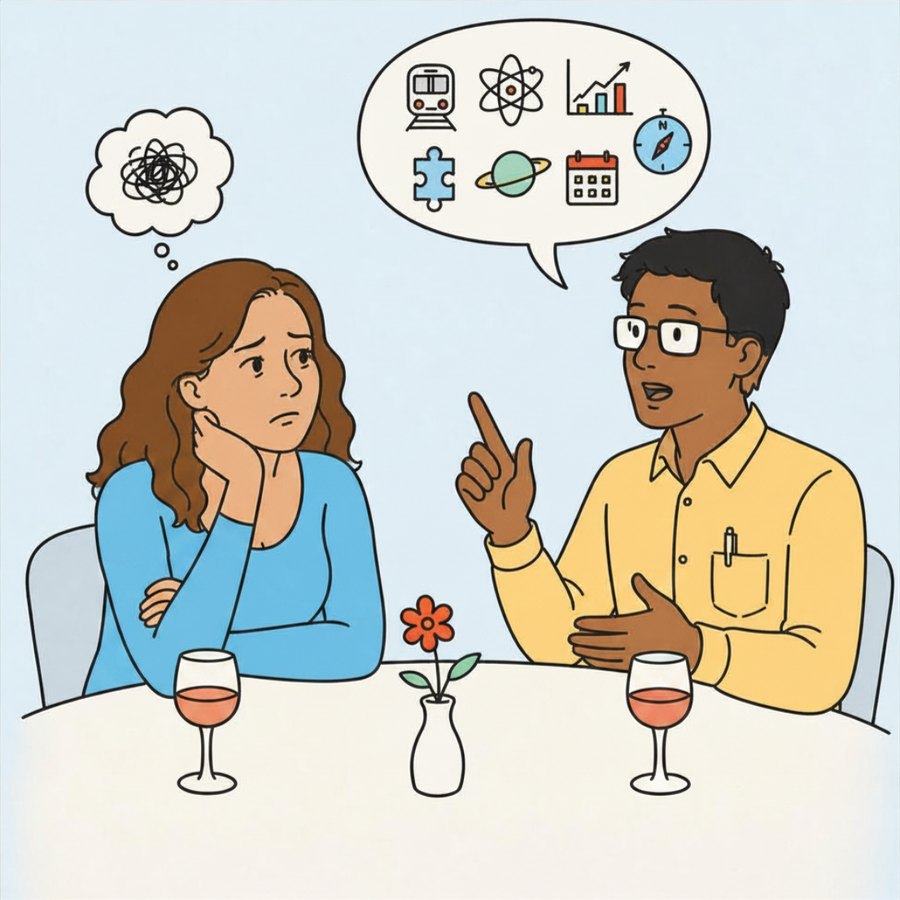
Neurotypical dating runs on subtext. You're allowed to ask for the text. Directness isn't a flaw to hide, it's a strength the right person will love.
Lead with your strengths
Start from what you actually offer, because it's a lot. Loyalty. Honesty, even when it would be easier to fudge. The ability to focus deeply on a person and a shared interest. Sincerity that never leaves someone guessing. Dependability you can set a watch by. And a passion for the things you love that's genuinely magnetic once someone gets to see it.
A huge number of people are tired, worn down by mixed signals, breadcrumbing, and partners who never quite mean what they say. Against that backdrop, your straightforwardness isn't a liability. It's a gift. You are, quite literally, the antidote to the thing most daters complain about.
You don't have to mask your whole self
Masking, performing a neurotypical version of yourself, is exhausting, and it isn't sustainable over the long run of a relationship. It also quietly defeats the point. If a connection is built on the masked version of you, you never find out whether someone likes the real one.
The goal is a partner who likes who you actually are, so let the mask down in doses that feel safe. You don't have to unveil everything on date one. But over time, showing your real rhythms, interests, and way of communicating is how you find out if this is a person you can relax around, which is the whole point of a partner.
Small talk is a skill, not a personality test
Small talk can feel pointless or baffling, and it's easy to assume you're just "bad at it." You're not. It's a skill, and skills are learnable and rehearsable. Preparing for it isn't cheating, it's smart.
- Keep a few reliable openers. Have two or three things you're comfortable saying at the start of a date, so you're not generating from scratch under pressure.
- Stock some go-to questions. "What have you been into lately?" or "What's the best part of your week been?" reliably open a conversation without feeling like an interview.
- Rehearse out loud. Practicing beforehand, even with a friend or in the mirror, is completely fair game and makes the real thing far less taxing.
Reading signals: ask, don't guess
The exhausting part of dating for a lot of people on the spectrum is the guesswork. Did that go well? Do they want to see me again? Was that a joke? Here's the freeing truth: you're allowed to just ask.
A direct question dissolves the ambiguity that trips everyone up, not only you. "I've had a really great time. I'd like to see you again, would you?" is clear, warm, and completely acceptable. Most people find that kind of clarity a relief. And if someone punishes you for being direct or makes you feel foolish for asking plainly, that's useful information: they aren't your person.
When (and whether) to disclose
Whether and when to tell someone you're autistic is entirely your call, and there's no rule. Some people share early to filter for acceptance and skip anyone who reacts badly. Others wait until they feel comfortable and the connection is real. Both are valid.
What helps is framing it as information, not an apology. Something like, "I'm autistic, which means I'm pretty direct and I might ask you to say things plainly rather than hint," sets a healthy, matter-of-fact tone. It tells the other person how to connect with you well. The right person meets that with curiosity and appreciation, not pity, and how someone responds tells you a great deal about whether they're worth your time.
Manage the sensory and social load
Dating takes energy, and you get to set it up in a way that works for you rather than against you. That's not high-maintenance, it's just knowing yourself.
- Choose settings that suit you. Quieter, more structured, activity-based dates often beat a loud, crowded bar, an activity gives you something to do and talk about instead of relying on constant open-ended chat.
- Build in decompression time. Don't stack a date on top of a draining day. Give yourself space before and after to recharge.
- Ask for what you need. "Loud places are tough for me, could we do a walk or a quiet cafe instead?" is a completely reasonable thing to say, and a good partner will happily meet it.
Online dating can help and hurt
Apps have real upsides here. A profile lets you present yourself clearly and deliberately, in writing, without the pressure of live improvisation, and you can prepare before you ever meet. That plays to your strengths.
But the same apps come loaded with the exact things that drain you: ambiguous texting, mixed signals, sudden ghosting, and endless reading of tea leaves. That can wear anyone down, and it can hit harder when subtext is already tiring to decode. More structured routes, like working with a matchmaker, remove a lot of that guesswork, someone else handles the ambiguous middle so you can just show up and connect.
Find people who value how you love
The goal was never to become neurotypical. It's to find your people, the ones for whom your wiring is a feature, not a bug. The right partner finds your directness refreshing rather than blunt, and treats your loyalty as something precious rather than intense. They exist, and they're often relieved to meet someone who means what they say.
You don't have to shrink or perform to earn that. You have to find the person who was looking for exactly what you already are.