 For everyone
Dating market
For everyone
Dating market
Are dating apps on the decline?
Published · 10 min read · By Julia, 4Keeps
Everyone seems to have a story right now about deleting Hinge. The feeling is real, but feelings make bad statistics, so we went and pulled the actual numbers: quarterly earnings from the companies that own the apps, national survey data, app-store measurement, and the event platforms where singles are turning up instead. Below is what the 2026 data actually shows, including the parts that cut against the "dating apps are dead" headline.
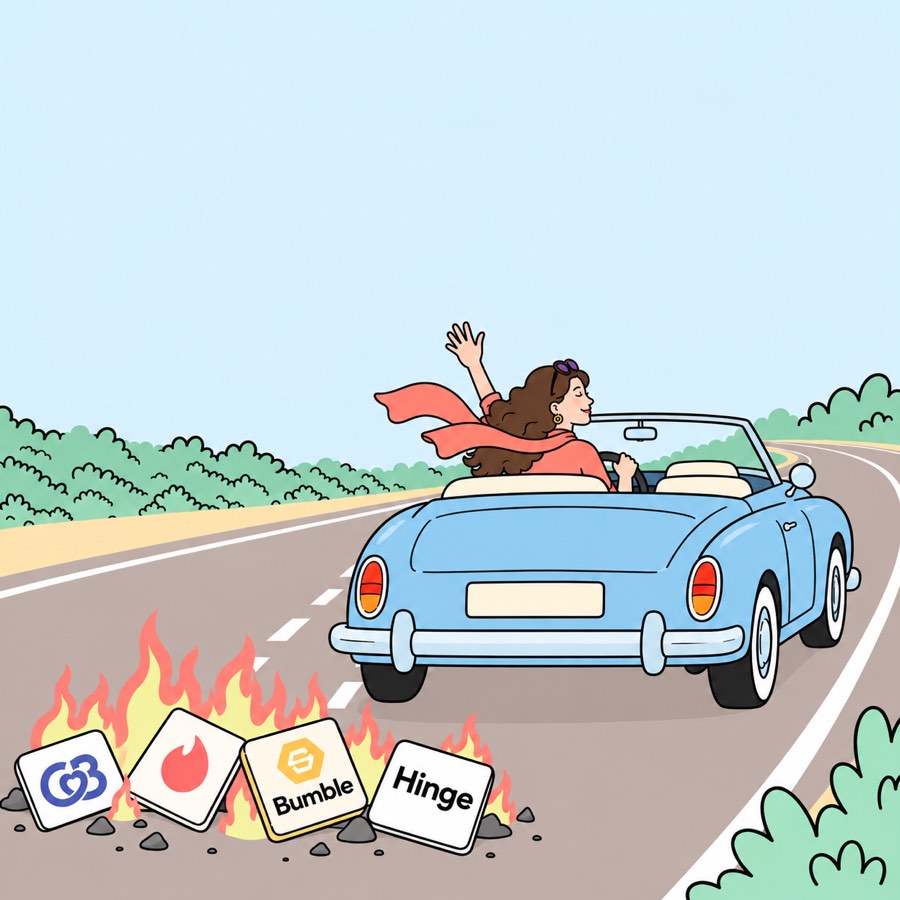
Short version: the apps are shrinking, not dying. Fewer people are paying for them every quarter, but the ones who stay are paying more, and one of the big apps is still growing fast.
1. The paying user base really is falling, for the fifth straight quarter
This is the cleanest evidence available, because it isn't a survey. It's audited numbers that two public companies have to report.
Match Group (Tinder, Hinge, OkCupid, Match, Plenty of Fish) reported for the quarter ended June 30, 2026: total revenue of $853 million, down 1% year over year, and 13.3 million payers, down 6%. That is the fifth consecutive quarter its paying user base has contracted. Tinder, still the biggest app in the category, brought in $457.5 million in direct revenue, down 1%, with payers down about 5% to roughly 8.5 million.
Bumble is in worse shape. Q2 2026 revenue came in at $210.5 million, down roughly 15%, and average paying users fell about 16% to 3.16 million, from 3.78 million a year earlier. Stretch the window to two years and the drop is close to 24%, down from about 4.1 million. The quarter also carried a $169.3 million impairment charge and a $127.9 million net loss, which is the accounting way of admitting the business is worth less than the company previously thought.
So on the single metric that costs someone real money, yes. The decline is unambiguous and it is still going.
2. It didn't start this year
The vibe shift feels recent; the data isn't. Sensor Tower was already measuring the slide two years ago: in Q3 2024, global dating app downloads fell 9% year over year and monthly active users fell 3%, with the US market worse at 14% fewer downloads and 8% lower MAU growth. Tinder alone was down about 11%.
One number in that report is more telling than the headline declines. "Resurrected" users, meaning people who quit an app and later come back, fell to 8.4% of users in 2024, from 11% in 2020. Historically the dating app business ran on a revolving door: you'd delete it after a bad month, then reinstall it in January. That door has been closing for years. People who leave are increasingly staying gone.
3. The part the "apps are dead" headlines leave out
If you only read the payer numbers you would conclude the whole category is collapsing. It isn't, and it's worth being honest about why.
- Revenue is falling far slower than users. Match's payers dropped 6% while revenue dropped 1%, because revenue per payer rose 6% to $21.13. The casual free-riders are leaving. The committed, paying core is spending more.
- Hinge is growing, fast. In the same quarter its parent company was shrinking, Hinge's direct revenue was up 22% and its monthly active users up 13% year over year, with 86% revenue growth in its European expansion markets. Hinge is the app explicitly built around "designed to be deleted," relationships rather than volume, and it's the one winning.
- The bleeding is slowing. Tinder's year over year daily active user decline narrowed to 4% in Q2, which Match called its best result in ten quarters. Bumble's own app lost just 5,000 paying users quarter over quarter, versus 103,000 the quarter before and 159,000 the quarter before that.
That is not a dying category. That is a category that got too big during a particular moment, and is now settling back toward the people who genuinely want it.
4. Why people are actually leaving
The reason matters more than the number, because it tells you what to do differently.
A 2026 survey of roughly 9,000 people by Clarity Check, reported by Fortune this month, found that 58% had deleted a dating app because they found it "emotionally draining," and 44% said they would rather meet someone in a low-pressure setting than get to know them through a profile. Note what that first number is not: it isn't "I found someone," and it isn't "the app didn't work." It's exhaustion.
Kathryn Coduto, a Boston University professor who studies online dating, framed the cause to NPR member station WHRO as a hangover from the years when everything moved online at once. "A lot of things went online, and people have missed connecting in real life," she said. On what people report missing: "People are often talking about missing that magical element, that moment of seeing someone." And on the swipe itself: "That novelty has really worn off, and now people feel like they're being really shallow."
Coduto also points out the thing that keeps the numbers from falling off a cliff: "People will keep [apps] on their phones as an option because they're really easy." Most people aren't quitting so much as demoting. The app stays installed, unopened, as a backstop.
5. Where those people are going instead
This is the most interesting data in the whole story, because the exodus has a destination.
Eventbrite compared its US platform data for the first half of 2026 against the same window in 2025. Events using "meet cute" language were up 117%, and attendance at them was up 128%. Hobby events aimed at singles grew harder still: trivia nights up 403% with attendance up 388%, mahjong up 235%, plus run clubs, pottery, plant swaps, and Pilates socials. Strava separately logged 59% growth in run club participation over two years.
The shape of that demand is specific. Eventbrite found 58% of young adults want socializing to be a secondary part of an experience rather than the main event, and 69% want events that combine different interests. Nobody wants to walk into a room whose only stated purpose is "you are here to be evaluated romantically." They want an activity with a side door.
The apps noticed. Tinder launched an Events feature this year; the company says 71% of its Gen Z users in Los Angeles tried it after the March launch, and 63% of users over 25. Bumble is pushing the same direction, telling Fortune that "one of the biggest points of friction in dating today is the gap between connecting online and actually meeting in person." The Dutch app Breeze skips the chat phase entirely and just books you a date; its cofounder Marco van der Woude argues that "a short real-world date tells you more about compatibility than weeks of texting, and it does it faster and with less of the anxiety and second-guessing that endless chat creates."
The market isn't rejecting technology that helps you meet people. It's rejecting the chat, the sorting, and the endless queue. It wants to be delivered to a table.
6. But step back, and online dating is still enormous
Recency bias cuts both ways. Here is the longer view.
An SSRS national survey of 2,012 US adults in January 2026 (margin of error ±2.5 points) found 37% have used an online dating site or app at some point, and 6% are currently using one. Among adults 30 to 49 it's 53% lifetime, and among 18 to 29 it's 51%. For LGBTQIA+ adults, 63% lifetime and 14% currently. Pew Research Center, asking a similar question in its last major read, put lifetime usage at 30% and past-year usage at 9%, and found that 10% of partnered adults met their current partner online, rising to 20% for partnered adults under 30.
And the outcome data is better than the discourse suggests. In the SSRS survey, 50% of people who had used online dating reported ending up in a committed relationship with someone they met there, and 58% of all adults said relationships that start online are just as likely to succeed as ones that start in person.
Stanford sociologist Michael Rosenfeld's long-running "How Couples Meet and Stay Together" data is the best evidence of how thoroughly this happened. Meeting online overtook meeting through friends as the most common way heterosexual American couples meet around 2013; by 2017, 39% of heterosexual couples met online, up from 22% in 2009. The apps didn't become a niche. They became the default, and a default losing 6% of its payers is still the default.
7. One honest caveat about the data
Different surveys give different numbers, and you should be suspicious of anyone who quotes them as if they agree. SSRS says 37% of adults have used a dating app; Pew said 30%. That is a real gap, produced by different question wording, different years, and different panels, not by 7% of America signing up in the interim. The earnings figures are the hardest evidence here because they are audited and legally binding. The survey figures are directional. The viral one-number stats floating around ("X% of Gen Z has quit the apps") are usually vendor marketing, and we've left most of them out on purpose.
8. So should you delete your apps?
Not on the strength of an industry trend, no. A market-level decline tells you nothing about whether an app is working for you. But the reasons behind the decline are worth acting on, because they're the same reasons the apps probably feel bad to use right now.
- Stop treating it as a feed. The burnout number is a symptom of open-ended browsing. Cap it: fifteen minutes, twice a week, with the goal of producing dates, not matches.
- Move to a real date fast. Every piece of evidence above, from Breeze's whole business model to the 44% who want low-pressure settings, points the same way. Long chat threads are where attraction goes to die. Suggest something concrete inside a few days.
- Add one offline lane. Not a singles event, necessarily. A recurring thing with the same people in it, which is what the run club and trivia numbers are really measuring. Repeat exposure is the ingredient an app structurally cannot give you.
- Fix the profile before you quit it. A lot of "the apps don't work" is really "my profile is filtering for the wrong people." That's a solvable problem, and it takes an afternoon.
- Notice which app you're tired of. Hinge growing 22% while Tinder shrinks is a signal about intent, not interface. If you want a relationship, being on the volume app is its own kind of headwind. Here's how to filter for intentionality.
What we take from all this
The 2026 data describes people who still very much want to meet someone and have simply run out of patience for the way the apps ask them to do it. They don't want a bigger queue. They want fewer, better introductions, delivered by something that already knows what they're looking for, with a real human being at the end of it.
Which, to be transparent about our bias, is the entire argument for matchmaking, and it's why this part of the industry is growing while the swipe economy contracts. You aren't handed a deck of strangers to sort. Someone screens, vets, and introduces, and the first thing you do is meet.
The apps aren't dead. They're just no longer the only option, and for the first time in a decade, that's showing up in the numbers.
Sources
- Match Group, Q2 2026 results (quarter ended June 30, 2026) — revenue, payers, RPP, Hinge growth, Tinder DAU.
- Bumble Inc., Q2 2026 results — revenue, average paying users, impairment and net loss.
- Fortune, "Dating apps are trying to cure swiping fatigue" (Sep 2026) — Clarity Check survey of ~9,000, Tinder Events adoption, Strava run clubs, Breeze.
- NPR / WHRO, "Have dating apps lost their luster?" (Aug 2026) — Kathryn Coduto interview.
- SSRS, "The Public and Online Dating 2026" — national survey of 2,012 US adults, January 2026, ±2.5 points.
- Pew Research Center, key findings about online dating in the US — lifetime and past-year usage, partners met online.
- Sensor Tower, "Users Separate from Dating Apps" — download, MAU and resurrected-user trends.
- Stanford, Rosenfeld et al., "How Couples Meet and Stay Together" — share of couples meeting online over time.
- Eventbrite US platform data, H1 2026 vs H1 2025, as reported by DatingNews — "meet cute" and hobby event growth.